Amelia’s StoryLa storia di Amelia
Complete English Story
Background
I was born in Catignano the 24th of July 1942. It is very hard to find Catignano on the map, it is a little town 30 km from Pescara. The house where I was born was 3 1/2 km from Catignano, I was the youngest of four born when my mother was 32 and my father 34. The oldest child was Rosina born 1935, then 2 sons: Domenico 1937 and Gino 1939. I was born in the middle of 2nd World War. My father was called to go to war but because he had 4 children he was exempt and he always said that I saved his life!
In 1939 my father separated from his brother Luigi and he bought 2 hectares of land, this is where he built the house where I was born. Later he managed to buy another 3 hectares so in total we had 5 hectares of land. It was here that I lived for most of my youth. The house had only 3 rooms: a barn big enough to fit 4 cows, a kitchen and one bedroom. In the kitchen we had a table 6 hand made chairs, shelves around the walls to store utensils, a fireplace and a little sink (with no running water). On top of the sink was a little cupboard where we used to put glasses and cups. Around the house you could see a shed made of cane used for storing goods, un forno to cook bread and other small sheds for animals. We use to have lots of animals: chickens, ducks, geese, turkeys, pigs, sheep, cows, a donkey and always a dog and a cat.
To survive in those days we had to farm the land and produce almost every thing (meat, milk, cheese, oil, flour, pasta, bread, all kind of fruits and so on). My mother use to make her own bed sheets out of linen and she also made linen table cloths and linen tea towels. She also used to knit and sew in wintertime. Even us kids had to help with the everyday chores. No hands were left idle.
My father was very ambitious. He was a very good farmer and a good provider, but he was also a very bossy and a very strict man. He would go to work in the field and would take the two boys with him and gave them jobs to do and no whinging about it.
My mother and us girls had to do the cooking, housework and feed the animals around the house and after we finished these tasks we would have to go outside to help the men.
In those days it was logical to make the children work; it was a way of life, small children small jobs big children big jobs!
I remember when I was about 5 years old I had to feed the young animals such as chicks, ducklings and turkeys, I had to pick up fire wood and pick the olives. These were very easy things to do but as you grew older you got more responsibility and harder things to do.
Although us children had to help working the land, at the age of 6 we also had to start school. After the war there was no special place called “school”. A teacher would go to a private house and all the children in the neighborhood would get together to learn to read and write. The teacher would have groups of children from 6 to 12 years and sometimes older. Because of the war some children missed few years of school.
I remember that my sister was going to school in a house about 3 km away from our home. I was about 4 1/2 years old and I wanted to go to school too, so some times she would take me with her. But because we had to walk so far and occasionally the road was muddy I used to get tired and she had to carry me on her shoulders. What a stressful time for Rosina an 11 years old! But I was so happy because I had so much attention from the teacher and all the other students.
School time was 8.30am to 1.30pm. In the afternoon you go home, have some to eat and by then some work was ready for you around the house or in the fields. Having 1/2-day school meant that children had homework to do which was done at night after their chores. I remember very well when my brothers and sister would sit around the kitchen table doing homework. I always wanted to sit with them and do what they were doing but of course I would only scribble on paper or annoying the others. At that time there was no electricity in the house and to do the homework we had il lume a olio, we had also il lume a carburo something like the moka expresso coffee machine.
Living in a small farm and working with primitive tools was not easy but we made the most with what we had and we managed to make enough food for us and some to sell to other people. Many others struggled just to get food on their table. There were people that would go to work just to get a decent meal.
At that time, many other farmers didn’t own their own land or a house, they had to work somebody else’s land, land of “Big Padroni” or rich people such as; baroni, conti or marchesi.
The system was referred to as sharecropping, where the land owner and the farmer would split the crops 50/50. However, many land owners would greedily write up contracts where they would take 3/4 and leave only 1/4 to the farmer. Basically the people who worked other peoples land were considered to be like slaves. Many farmers would have to steal some of the owners crops and sell them at the local markets to make some extra money to help their families.
The work of a farmer was considered the lowest job in society. Farmers were discriminated against by the people who lived in town. I remember well when we went to the market or to a festival in town you could hear people saying, “There are a heap of peasants in the piazza.” They were harsh words, especially since it was the farmers who supported the town by selling their fresh produce at the markets.
Every Monday my mother would go to the markets to sell our goods. She had to walk 3km into town with a basket balancing on her head full of chickens, eggs, fruits and vegetables. My father would go to the fairs to sell live stock; pigs, calves and lambs. The money we made from these goods would go to buy sugar, salt, shoes and clothes.
To survive we had to make many sacrifices, we were always working, paying our taxes and praying to the Lord for a good crop because a lot of times bad weather would destroy everything. My father was very ambitious and wanted to provide our family with a better life, but there was little hope to see this progress he desired.
As peasants, the cultural divide of that time didn’t allow for growth. If you were born in poverty, you died in poverty. This was because the social system was not equitable and 80% of farmers born before the first World War were illiterate. My father did not go to school, instead he learnt to read and write from his younger brother (Luigi) who did go to school. My grandfather believed, as my father would always tell me later, that only one person in the family needed to be able to read and write.
My mum, Aida Di Clemente went to school for only 2 years. She came from a family of 11 children, 4 girls and 7 boys. As she was the eldest girl she had to stop going to school to help around the house and look after her younger siblings.
The Di Clemente family was a little better off. My grandparents Guistina and Michele ran the mill of Baron Corvi. All the farmers in the area and in neighboring towns would come to grind their wheat at the Corvi mill. The mill became known as “Maccaccione Mill”, which was my grandfather’s nickname. The mill ran really well and it was fairly profitable.
My grandparents were always busy serving the needs of their clients so the eldest children had to run the house, tend the land, do all the chores and sell their fruits and vegetables at the market.
In 1934 Aida was married to Costantino Trabucco. Costantino had 6 sisters and 4 brothers (two of which died in the First World War, Enrico and Valentino). Even Costantino’s parents, Domenico Trabucco and Rosa Lizzi, ran a mill but it was much smaller and less popular. It was called the “Mulinuccio” and it was situated 3km from Catignano in the Sterpara district, very close to Michele Maccaccione’s mill.
After they were wed, Aida went to live with Constantino together with her in-laws and with her brother in law, Luigi. Luigi later married the war widow Rosa Ranieri who had two small children, Antonio and Nicetta. The two brothers lived together for 5 years, which was common in those times.
Then their families began to grow. In 1935 Rosina my sister was born and in 1937 my brother Domenico was born. It became impossible to live in the small house with 4 children. My father decided to get a loan and bought some land in Verano, Catignano, it was an area far away from the main road. In the same year, 1939, my brother Gino was born. Right after his birth my family moved to their new house in Varano. Three years later I was born in 1942.
Where we lived there were no paved roads, no running water and no electricity. My mother was used to these utilities and she suffered a great deal when they first moved. Later as with many things, she learned to adjust and make do with what we had.
World War II
Mussolini (1883- 1945 ) Italian Statesman, il Duce, the leader of the fascist movement who governed the kingdom of Italy as prime minister from 1922 – 1943 but was in fact a dictator from 1925.
The 2nd world war started in September 1939. In 1942 it was a critical time for Italy and Mussolini needed extra troops to fight against France and Great Britain. He ordered the inscription of men who already had families so my father was obliged to join. When he went into town to enlist, I had just been born. The enlistment officers told him that men with 4 or more children no longer had to join. From that moment on I became his favorite child.
I remember very little of the war. I remember a German soldier who always came to our house to eat. He would pick me up in his arms and tell me that he left a baby girl like me back home. Some times he would bring us gifts. I also remember the sounds of the aeroplanes and the bombs dropping. One bomb landed very close to Zio Luigi’s house. Our parents would work in the fields and we would have to stay at home. If we heard a plane we had to run inside immediately and hide. Because I was the youngest I didn’t understand the danger and I always wanted to go outside. Domenico was responsible for us younger kids and he would lock the door so I couldn’t go out and I would get angry and try to bite his stomach.
The war ended in 1945 leaving in its wake a destroyed and miserable country. My parents told me that citizens were forced to give up their gold to help pay off the debts of the war. Benito Mussolini was assassinated on the 28th April 1945. After many blunders during the war, the king of Italy Enanuele III, reliquished his powers to his son Crown Prince Umberto. Within a year public opinion forced a plebiscite to decide between retaining the monarchy or becoming a republic. June 2 1946, Italy votes to becomes a republic with 54%. After this her economy was restored a little but it was still a country in crisis with poverty and desperation, especially for people who lived in the country like us. We just had to work and work and work to make ends meet.
Farm Life
A lot of times our parents had to go away to work and us kids had to stay at home. As usual, the older kids had to look after the younger kids. We had to do all the chores around the house, feeding the animals, picking fruit etc. Giving responsibility to a child of 9 or 10 years is dangerous, at that age a child can not work the same way an adult can.
One day my parents and Rosa went to work close to the river near where nonno Maccaccione lived. The three remaining kids were left at home. A few meters from our house there were some cherry trees but they were not on our land. As soon as we stepped outside our house we saw these beautiful ripe cherries. I was overcome by a crazy urge to eat some so I asked Mimi (Domenico) if he could get some for me. He replied that dad told us not to go anywhere near them because they are not our trees. I begged him to get me some and I told him that dad had cut some down for me with a scythe. To shut me up Domenico picked up the scythe and started to hack at the branches. The first one to come down was quickly picked up by Gino who was older and faster than me. Mimi told me to be patient and that he would get one for me too. He continued to swipe at branches but because the scythe was so heavy it would fall to the ground every time he swung it. In the meantime I had moved but Mimi had not noticed. I kept my eyes on the ground for a fallen branch or fallen cherries so I did not notice when the scythe swung down and cut my neck.
Mimi, petrified, brought me into the kitchen and poured some water onto the wound and then wrapped my dress around it to stop it bleeding. Then he told me to sit down and not move. Gino and Mimi sat outside worrying that dad was going to kill them what what happened.
Rosina came home first and when she heard what had happened she ran to tell our parents the awful news. She told them that Mimi had cut my neck with the sickle. My mum couldnt speak, her heart started to race at a million miles an hour as she thought my head had been completely cut off. As soon as I saw her I told her, “Ma, Mimi’ ma taiat lu coll ch la fauce,” she just gabbed me and hugged me thanking the Lord that I was still alive and talking!
Back then it was rare to have any disinfectant at home. They disinfected the wound with urine and immediately took me to the doctor on the donkey. I didn’t cry but I remember when the doctor was stitching me up that it burned. I said to mum, “Ma, pia la pezz,” which means, “Mum go and get a band-aid.” The doctor was surprised that I didn’t cry. He told my mum to ensure that I did not move my head otherwise the stitches could tear and I’d be left with a big scar. At that age it was impossible to keep still so predictably I had a huge scar across my neck for the rest of my life. Dad ended up buying that land with the cherry trees immediately after my accident.
Another accident occurred (as usual when our parents were not home) when Gino asked Rosa to cut some bread. She said no so Gino got a knife and started to cut it himself, but instead of cutting the bread he sliced his hand. He had a big cut between his thumb and index finger. Rosina, did a bit of first aid and then we all went to bed. In the morning, when our parents found out what had happened they had to take Gino to the doctor. He had to have seven stitches in his hand. It just so happened to be the same doctor that sewed me up! He said to my father “ You have very strong and tough children, they never cry!” My Dad was very proud.
When you made bread you had to leave a bit of the dough to dry out for a week. This would turn into the yeast you would use for your next batch of bread. Thing is, I only looked at how it was done I never actually did it. Rosa would always boss me around I would never want to do it. But then I didn’t do something she would beat me up.
We used to work all the time. Women had to learn how to sew but I used to hate it, I couldn’t stand it. I always wanted to go to my nonnos mill because my nonni and all my cousins were there and because there were delicious watermelons growing in the fields. One day mum brought me there but I wasn’t allowed to go into the fields where the watermelons were growing, I had to stay in the house. My aunty gave me a needle and thread and told me to start mending some trousers. I was only 8 or 9 and I had never done sewn before but I couldn’t say no because if someone older than you tells you to do something you have to do it! So I had to try. I was upset because I came with mum because I wanted to eat watermelon but instead I had to work! Then in the afternoon I went into the field to meet up with my mum and my uncle brought me a huge watermelon and a knife. I ate about 3/4 of it then I said to mum that I couldn’t finish it. You don’t have to eat the whole lot! She told me. An hour later we walked home, it was about a 3km walk and I thought to myself, I wish I had some of that watermelon now!
We made everything on our farm. I remember having to slaughter a pig. They would scream so loud I will remember it forever, I was so scared! One time Pop told me that I had to help, I was probably 9 or 10. I had to hold the tail of the pig. The pig was on the table, Gino, Mimi and Rosa were trying to hold down the pig, I was at the tail and mum had a big pot under the neck to collect the blood. Pop put the knife through his throat into his heart. The pig screamed and screamed until finally it was dead. The blood was still pouring out and mum had to constantly turn the blood otherwise it would clot.
With the blood we used to make a jam called Sanguinaccio, it was so delicious! When we came to Australia we made this again. We went to the Italian butcher and asked for some blood. We used to cook it up with wine, pig fat, fruit, nuts. I used to bring Salata biscuits with this black jam to work and eat it every morning tea with a cup of tea. One of the Australian girls that I worked with said to me, “What are you eating?” And I said, “Jam.” She asked me the same thing the next day so I asked her if she wanted to taste this home made jam. So she tasted it and thought it was good. I said to her, “Do you know what you just ate? Jam made with pigs blood.” She shrieked and gagged and called me all sorts of names! It was so good though!
I remember when I was little and I used to have this on my bread, we never used to have sweet things so when you have this sanguinach I used to scrape it off the bread and put it on my hand, then I would eat the bread first and eat the sanguinach last!
Back to the pig, once he was drained we would have to open him up and take all his insides out and burn all the hairs on his skin. Then we would keep the carcass hanging in a cool place for about a week. We would usually do this in wintertime around Christmas. It was like a festival for us. We would then make all sorts of things like sausages and salami and then we would prepare to make the prosciutto. We would be lucky enough to eat some of the meat with polenta and sauce. We would use every single part of the pig, we would only throw out what was inside the intestines. The intestines were used to make sausages so we would clean them really well with salt and vinegar. We would scrub them and then turn them inside out and scrub them some more. Mum used to cook chicken intestines too! You would clean them really well and cook them with the feet. Kids used to eat that bit because the good meat would go to the adults. It was sad because you kill this animal, especially the lambs at easter time but we didn’t have butchers to buy meat, you had to kill your own at that time.
Pop
In the 1950s, we were still struggling to make a better life for us. Pop decided to immigrate to Venezuela, where we had some relatives working there. He thought that he could earn a lot of money.
The Head of the Family went away and we had to look after the farm and the animals. My Mum took on the biggest role ever! She had to step into my fathers’ shoes and take over not only the running of the house and family but also the land. Lucky we had some help from friends and family. She succeeded in keeping the house afloat and as a result Dad came home after trying for 18 months to make a life in Venezuela. He realised that he could sustain himself there.
In 1952-3 the economy improved a little and there was an opportunity to learn other jobs. Rosina went to learn how to become a dress maker. Domenico went to work in Pescara, first he went to work in a tap making factory and then he went to work as a mechanic. Gino was a little younger and had to stay and help on the farm. Pop was a very proud man and he wanted all his kids to go to school and learn a trade. However, money was always short and there weren’t many schools in the area for us to go.
Later on dad sent Gino to music school and bought him an accordian fisarmonica. Gino had to travel into the paese twice a week for music lessons.
School
I started school in 1948 in Contrada Collemaggio. Collemaggio was a group of farm houses which were about 300 meters from each other. They were in the Nocciano area which is 1/2km from my house. The school consisted of 2 rooms, one classroom and one kitchen, which were used for 20 children from 1st to 3rd grade all mixed together. The school days were short because we were in a zone far from town with no public transport and muddy roads not many teachers would want to work at Collemaggio.
I don’t remember all my teachers because almost every 6 months we had a new one. I only remember my grade 2 teacher, “la maestra Milena”. She was from Catignano and she used to sleep at the house and go home on the weekends. She organised after school classes for girls to teach us how to knit, sew and embroider.
After I finished grade 3 I went to do grade 4 and 5 in Contrada Sterpara, which was near Baron Corvi’s Villa. This school as also just a room in someones house. It was Zio Luigis house who had already immigrated to Australia, so only his family remained in this new house which had just been built. At the end of the 5th grade my results were excellent and my teacher encouraged my parents to let me continue studying since a new middle school had just opened in Catignano.
To start middle school you need to write an application, pay a small fee and take an exam. My grade 5 teacher gave me extra lessons after school to prepare me for this exam. I did not pass! It was my first disappointment! I was very upset because I knew my parents didn’t have much money but luckily enough, they let me try again.
The next year I had to study hard, I went to stay at Catignano at zia Giuseppina’s house and with my cousin Donato we took private lessons to be prepared for the big exam. We passed and in September 1954 we started middle school together. I was jealous of Donato, he was intelligent and more open mind than me and he didn’t need to study a lot to get good results. Instead, I was timid and I had study hard to get good grades. I was raised in the country and I was used to this environment, going to school in town was hard and I felt out of place but I did my best and I passed all 3 years.
The expectation when I finished middle school, was to continue studying and find a good job at the end of it all. My next problem was to choose a specific field to study. I did very well in maths, so I applied at the Istituto Tecnico where the courses leaned towards accounting and office work.
In 1957 I started the high school in Pescara at the ISTITUTO TECNICO “TITO ACERBO”
Going to school in the city was another big step for me. There were lots of students, lots of noise and lots of subjects to study. Traveling from Catignano to Pescara by bus was too far and inconvenient so I stayed with a family (paying board) close by the institute.
I found the course very hard, in fact I had to study during the summer holidays to sit an extra test for the subjects I didn’t pass in June. It was always Italian, I was very bad at writing!
Rosina
When I was at middle school, Rosina began a relationship by correspondence with Gabriele DiDonato who had already migrated to Melbourne, Australia. In 1955 Rosina married Gabriele by proxy and the year after she left Italy to be with Gabriele, her husband. She was only 20 years old. I was 13 when she left home. I thought it was a very strange thing to do, marry a person who she had never seen before, she had only seen him in photos. Maybe she no longer wanted to put up with our strict father? In any case it was a common occurrence in those days to be married by proxy.
Lots of people would get married just for the opportunity to move overseas. Once one family member was established in another country the rest of the family could join them. So once Rosina was in Australia she then requested Pop and Domenico to come over. It was organised so that they would leave together but there were some unforeseen circumstances which changed that.
Domenico (Mimi)
In Italy, up until recently, it was compulsory for men to do 18 months of military training once they turn 21. In 1959 Domenico and Pop were scheduled to leave for Australia in mid March but a few weeks earlier we found out that Domenico’s letter summoning him for military training was already in town waiting for him. His retells his story here;
Mimis transcrips
Immigrating
Pop left on his scheduled date onboard the ship ‘Sydney’ and arrived in Melbourne after a 26 day journey. Our family of 6 people was now split down the middle, 3 were in Australia and 3 remained in Italy. Communication between the two countries was very slow, we could only send letters which would take 2-3 weeks to arrive.
I was still at school in Pescara. Mum and Gino were at home in Varano but they could not run the farm with just the two of them. We decided to rent the land to another farmer and we rented a small apartment in Catignano. It was much easier for me to get to school on the bus from this apartment so I no longer had to board with the other family.
Gino was approaching 21 and would also be required to do military duty unless he too left for Australia. One day a letter arrives from Pop asking me wether I wanted to continue my studies in Italy or leave for Australia.
I was unsure what to do. I did not want to live in a divided family and I was also unsure about school and wether I could pass the next 2 years. I was in the 3rd year of school and it was already hard. Getting to the 5th year and going through exams was not very appealing. And then there was the issue of getting a job at the end of it. There is a lot of bureaucracy that exists even today, if you know someone you can get ahead otherwise you tend to get overlooked for jobs.
After much debate I wrote back that I would prefer to come to Australia. Once the decision was made there was a lot of work to do to prepare for the trip. I continued with school until just a few weeks before we left. I was learning English at school but once I knew I was coming to Australia I took extra private lessons.
On march 20 1960 mum, Gino and I left Catignano. The day after we were in Napoli and we embarked on our long journey on the ship ‘Roma’. Next morning we were in Messina, Sicilia, where more people came on board. Two young Sicilian girls shared our cabin while Gino was placed with other men.
A few days later we stopped at Port Said, then we entered the Suez Canal, down the Red Sea for our next stop, Port Aden in Yemen. In Port Aden we were allowed to disembark. We went walking into the city and for the first time in my life I saw a lot of very dark skin people and women wearing dark long dress with their face completely covered. It was a dirty, stinky place and I remember seeing people sleeping on the ground on the straw. I never imagined that people could be that poor and mistreated. We left our country because we believed that we had nothing, but these people were 1000 times worse off than us. It seemed to me that they were being treated like animals.
After we had left Aden we didn’t see the land for about 10 more days. Luckily our ship was pretty big, it had 2 swimming pools, first class, second class, a big kitchen and huge eating hall. There was music and dancing at night; but we (girls) were not allowed to go. Gino and his friends use to come and see us to chat and play games so we had a good time never the less.
The worst part about our trip was walking in the corridor, it was very narrow and you would have the sensation of being sea sick. From Sicily to Port Said we all got sick but after that we got used to it and we were fine. Mum however, was sick the whole time. She couldn’t eat in the dining hall because the smell of food made her feel sick. Instead I had to bring her sandwiches or fruit to eat.
The first stop in Australia was in Fremantle. I remember going out to buy an ice-cream. I put some money on my hand and I said, “Can I have an ice-ceam?” I don’t remember saying please and I have no idea how much I paid.
From Fremantle to Melbourne the sea was so rough, glasses and plates fell from the shelves and broke. We hardly could walk around or go to sleep. It was a hell of a 5 day journey.
Finely we arrived in Port Melbourne on the 15 of April 1960; but it was Good Friday so no one was working at the docks. We had to stay on board until the next day!
Life in Australia
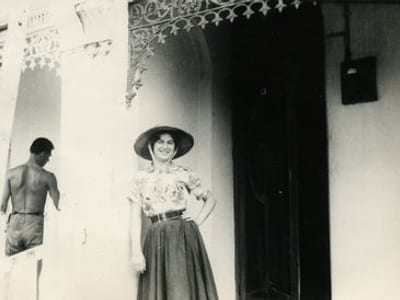
We finally disembarked and made it to Zia Rosas house. Zia Rosa used to send us photos of the house where she lived in Australia. It was on glossy paper and at the time I thought the wrought iron work on the verandah was made from gold or silver. I thought, why are these houses made so nice?! But when I arrived I was shocked because it was just rust! The houses were smaller and all the same height unlike in Italy. Mum was happy though because the houses had running water, we didn’t have water where we were in Italy. Mum was brought up where there was electricity and running water but where pop built his house it was really in the middle of no where. There wasn’t even a road. She was really happy when she came to Australia. She didn’t work but she ran the households and did all the cooking, cleaning, washing and shopping for all of us.
Next door to Rosa lived Francesco Cicuccio who lived on his own. So mum, pop and I stayed there while Mimi and Gino stayed with Rosa.
I knew a little English from school but I had learnt more French than English. When I went to the shop I used to speak French because it came easier but of course they didn’t understand me! English was just not coming out, if I could read I could understand it ok but it was impossible to speak. I couldn’t understand when people spoke to me because their pronunciation and accent was really different from what I learnt at school.
Rosa sent me to the milk bar round the corner from her house in Laura St to go buy some matches. When I went there I said “smatches” or something like that and the lady didn’t understand me, she told me to look for it and point to what I needed. When I found it she told me these are called Matches!
Work
We all got jobs very quickly but I thought maybe at some stage I could continue my schooling. But it didn’t happen. After 2 days my sister brought me to the factory where she worked. We had to catch the tram, a bus and then another tram. I remember Zia Rosa told me I had to pay one and two, which was one shilling and two tuppence. So she instructed me to say one and two and he will give you a ticket. I didn’t like where we worked, it was dirty and the owner was shifty. He used to follow the girls going to the toilet. My sister told me to be careful and if I saw him to call her and she would tell him off. It was a jumper factory and I learnt to read patterns and how to fold jumpers for sewing. It was a very small factory in Smith St Collingwood. My starting wage was £7 per week.
I only stayed at my first job for 6 months because Rosa was expecting Fabrizio and I didn’t want to stay there without her. Going home one day I saw a sign at Sperling Knitwear on Lygon St saying junior wanted. So I went to enquire about the job and they told me I could start the next day. It was still a knitting factory also run by Jewish owners. I learnt how to cut with a machine and I met a really good friend there called Dora from Sicily who worked in ironing. She was married and then had a baby, Roberta, who Mimi and I are Godparents to. She ended up returning to Italy.
At Sperling knitwear when the bosses would leave to go to the market, they would give me the responsibility to answer the phones. I don’t know why because my English was not very good. I couldn’t properly understand people talking on the phone, can you imagine after only one year after coming to Australia?! People would call from interstate to make orders so I had to ask an Australian woman to talk on the phone for me. That’s probably why I hate talking on the telephone even now! I just hate it! Anyway I did my best.
I eventually got fed up at Sperling Knitwear so I went to do some office work for an Italian funeral parlor, Giannarelli, who are still around today. It was so yucky and dirty. I had to look at the Sun newspaper and send pamphlets to families of the deceased. There was so much to do because they were so behind with paper work. I worked one day and they gave me the job. They were going to pay me more than Sperling so I had to decide what to do. I thought about all the men I saw working at the back of the office who had whistled as I went past and I though, shit I don’t want to work here! Especially since there were no other women there, I was a bit scared. So I went back to Sperling Knitwear and told them I had found a job which paid more and I was leaving. They offered me the same money and told me to stay so I did but I wasn’t really happy.
After 18 months in Australia we all put our money together and we had enough to buy a house. In 1961/62 we bought a house in Albert St costing us £1500 (in 1964 Australia changed to use dollars). Rosina stayed at her house in Laura St with Gabriele and Fab but the rest of us moved to our new home.
I found a job at Alto Knitwear, another factory in Nt Fitzroy still making jumpers but this time run by Italian owners. I brought over Maria Panara from Sperling. Because Non could look after Fab, after 6 months Rosina went back to work, she also joined me at Alto Knitwear and later became a supervisor. It was very close to her house and she used to walk to work. I was working in the cutting department with an Australian woman. That was the time I made her try the Sanguinaccio made with pork blood. The photos when were were dancing were taken in that factory.
In 1964 Pop went back to Italy and organised a trip San Gabrielle in Abruzzo at Monte Corno the tallest mountain in the Alpine ranges. There is a sanctuary of San Gabrielle who is the patron of Abruzzo. My Nonno (Michele DiClemente) when he was about 12 he fell really ill. The doctors thought he was dead as he was not breathing. A zia went to say a prayer and pulled back the sheet which covered him. He spoke to her and asked for a glass of water. This zia got the shock of her life and ran to tell his mum that he wasn’t dead and that he had spoken. She was in such a hurry that she fell and broke her arm. She went back to him and asked him, “Where did you go”. He replied that he had been on a very long journey and he found myself at a church, a convent for monks with lots of rooms. Each room he went to the monk told him there was no room, so he went to the next room but it was the same story. He kept doing this until one monk said he should turn around and go back because there is no room for him here and that is when he woke up. They thought it was a miracle so they took the coffin which they had ready for him to San Gabrielle as thanks. This is why we have been devoted to this saint. Pop always wanted to do these trips.
Ernesto
In 1964 Fernanda came to Australia with her family, Walter, Pierino and Vienna. She started working with me at Alto Knitwear shortly after, she was only 14 but I told the boss that she was 15 which was the legal age to work. Zia Vienna got a job in the finishing department and Zio Pierino worked with Gino at Ford.
Luckily they came because I was not allowed to go out. It was an old tradition that girls had to stay home. Domenico used to take me to the movies, I enjoyed going to the cinemas but as I got older 19, 20 years old I didn’t like it so much because I thought no one was going to talk to me because I was with Domenico and it would have looked like he was my boyfriend, people wouldn’t know that he is my brother. When Zia Fernanda came she was only 15. After a few years when she turned 18 I told Gino that we should organise to go to the dances at Brunswick town hall. The dances were from 7pm to 12am and that was it, after that you went home, not like now where people stay out all night! Walter and Gino used to come with us to the dances and that is where I met Ernesto. Zio Pierino used to love to dance and he would take us sometimes too. At the time there were so many single Italian boys who had immigrated on their own and there were very few woman. So when the music started it was like a swarm of bees going to a flower! I was asked to dance all the time. I was raised to be polite so if someone asked me to dance I would say yes, even if I didn’t really like them. When Ernesto came over to ask me to dance I had already promised myself to dance with someone else. I was kicking myself because I liked Ernesto and I didn’t particularly like the guy I was going to dance with. I said to Fernanda from now on I would just say yes to a dance with the guys I liked! Ernesto said he would wait until the next dance and I said ok. So we danced and talked and asked each other questions. Then he asked if he could see me again. I said that I might be going to church the next day. That night we were walking home because we lived close to the hall. Ernesto drove by and waved and I waved back. Luckily Zio Pierino didn’t see me! The next morning I went to church but I didn’t see him. I was devastated because I really liked him and I wanted to see him again. Then much later, I saw him come in. He was very late and I found out later that that was the type of person he was, he was always running late!
Then I had a lot of problems with my dad because he wouldn’t allow me to go out. Ernesto said to me once, I’ll come to your house to pick you up? I told him he could come but I couldn’t say what would happen. Pop used to go over to Zio Pierino’s house when Ernesto came over to visit. One night I had a really big fight with my dad, because he said to Ernesto, why are you coming here to see Amelia? Ernesto replied, if you don’t want me to come in why don’t you just keep the door shut and don’t let me in? Mum was in the middle and she calmed pop down but he was very angry. I didn’t talk to him for 2 years even though we were living in the same house. We would avoid each other but I would still talk to mum. Pop would say, why do you like this boy? We don’t know him, we don’t know if he has a wife in Italy!? I was almost 25. Ernesto called me one day and said, I think your dad doesn’t want me around. If I can’t see you I’m going to go back to Italy. I was devastated just thinking about losing him so I sat down and wrote him a letter, if you love me I’m prepared to leave my parents…I said this even though I didn’t think I could actually leave them! Lucky enough Ernesto came back to me and stayed in Australia. He told me that he had bought a block of land in Ringwood. He was living in Ringwood and could only come to visit me in Brunswick twice a week. Gugliemo remembers going to Box Hill to go bowling and he would see Ernesto flying down Maroondah Highway running late for a date with Amelia!